
Your Partner in Health and Wellness
Location

What Are Allergy Test Panels?


Which Panels Are Available?
Food Allergy Panel
Helps evaluate common food allergens such as eggs, milk, wheat, hazelnuts, fish, seafood, fruits and vegetables.
Respiratory Allergy Panel
Helps evaluate sensitivity to pollen, house dust mites, molds, animal dander and other allergens encountered through inhalation.
What Do Allergy Test Panels Provide?

Determining Allergen Sensitivity
Helps evaluate sensitivity to specific food or respiratory allergens.

Comprehensive Screening
Multiple allergens can be examined within the same panel.

Support for the Diagnostic Process
Contributes to clinical evaluation in patients with suspected allergy.

Treatment and Follow-up Plan
Together with specialist evaluation, results can support the follow-up and prevention plan.
EUROIMMUN
Which Test Do We Use?
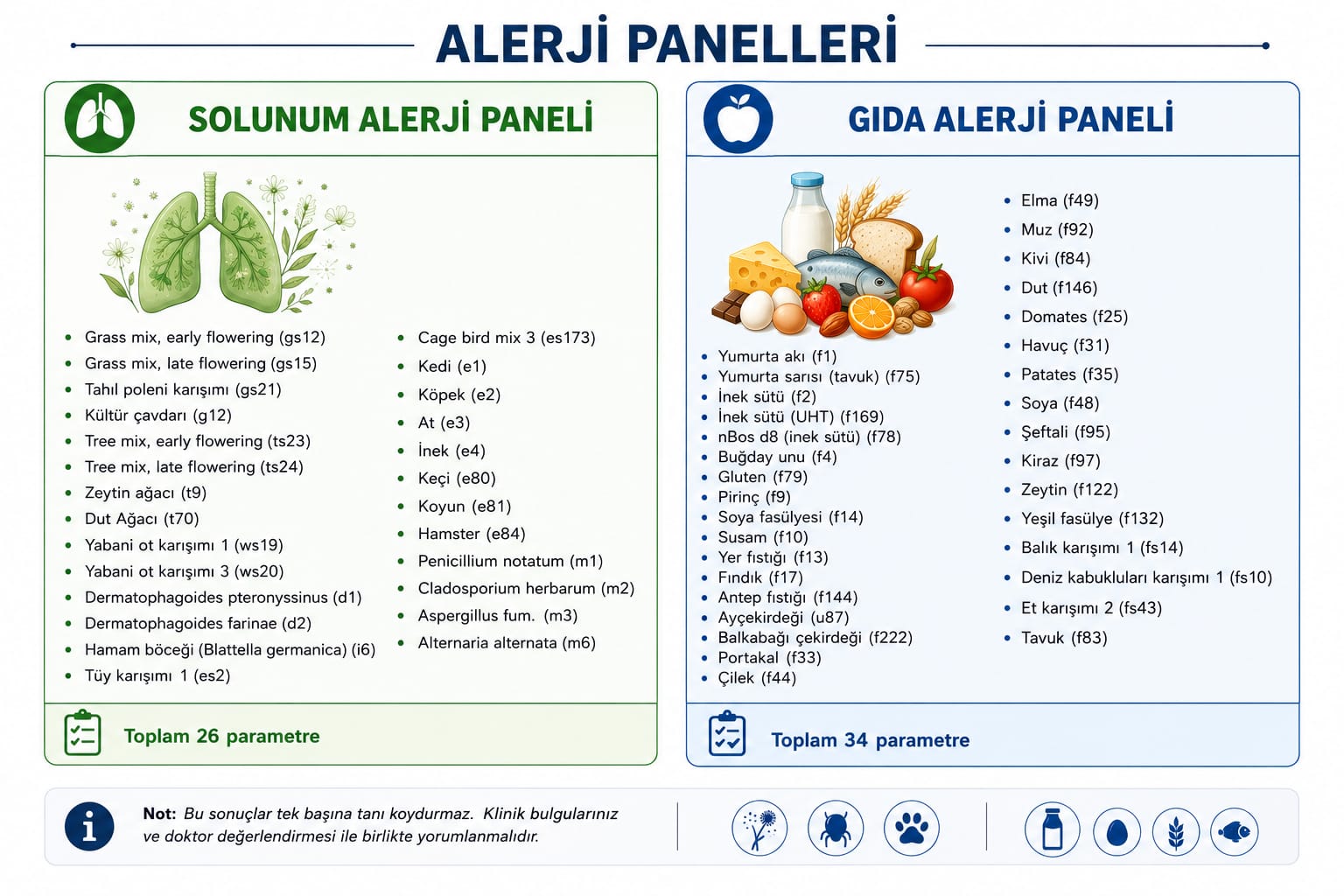
Food Panel (35 parameters)
Egg white(f1), egg yolk (chicken)(f75), cow's milk(f2), cow's milk (UHT)(f169), casein(f78), wheat flour(f4), gluten(f79), rice(f9), soybean(f14), sesame(f10), peanut(f13), hazelnut(f17), pistachio(f144), sunflower seed(u87), pumpkin seed(f222), cocoa(f73), orange(f33), strawberry(f44), apple(f49), banana(f92), kiwi(f84), mulberry(f146), fig(f328), tomato(f25), carrot(f31), potato(f35), onion(f48), peach(f95), cherry(f97), black olive(f122), green bean(f132), fish mix (fs14), shellfish mix (fs10), meat mix (fs43), chicken (fs83).
Respiratory Panel (26 parameters)
Grass (early), grass (late)(gs15), grain pollen mix(gs21), cultivated rye(g12), tree (early)(ts23), tree (late)(ts24), olive tree(t9), mulberry tree(t70), weed mix 1(ws19), weed mix (ws20), dermatophagoides pteronyssinus (d1), dermatophagoides farinae(d2), cockroach(blattella germanica)(i6), feather mix (es2), caged birds 3 (es173), cat(e1), dog(e2), horse(e3), cow(e4), goat(e80), sheep(e81), hamster(e84), penicillium notatum(m1), cladosporium herbarum(m2), aspergillus fum.(m3), alternaria alternata(m6)
Our Other Panels
Our Specific Allergy Test Panels
- Beta-Lactam (Penicillin) Antibiotic Allergy Panel (5 parameters)
- NSAID (Painkiller) and Paracetamol Allergy Panel (5 parameters)
- Occupational Allergens Panel (7 parameters)
- Bee Venom and Insect Allergy Profile (7 parameters)
- Gluten Allergy and Intolerance Profile (9 parameters)
Alex Test300 parameters
- The most extensive molecular allergen panel
- Pollens, house dust mites, animals, molds, foods and the venoms of insects such as bees
- Milk, eggs, wheat, nuts, legumes and seafood
- Performed on a blood sample taken from the arm
- Analysis time is approximately 2 weeks