

What Is Carrier Screening?
Who Is It Suitable For?

Couples planning a pregnancy

Individuals with a family history of genetic disease

Consanguineous couples

Individuals seeking a comprehensive risk assessment before pregnancy
What Is GeneScreen?

Many studies have shown that:
In 80% of couples who have children born with a genetic recessive disorder, the parents have no symptoms.
Each individual is a carrier of an average of -2.8 pathogenic variants.
Approximately 1 in 4 people (24%) is a carrier of at least 1 gene mutation, and 1 in 20 people (5.2%) is a carrier of multiple gene mutations.
1 in 20 people (5%) is a carrier of a gene mutation, 88% had no prior family history, and 1 in 240 were high-risk carrier couples with a risk of having a child with a gene mutation. This is why carrier screening tests are important.
We Are Just a Message Away
Reach Us on WhatsAppGeneScreen®: About Genetic Carrier Screening
Frequently Asked Questions
What is the GeneScreen® test?
GeneScreen® is a genetic test that investigates whether prospective parents are carriers of certain inherited diseases. Offered by Eurofins Genoma, the test helps couples assess genetic risks they may pass on to their children and make informed pregnancy plans.
What does it mean to be a carrier of a genetic disease?
Being a carrier means carrying a genetic variant associated with a disease. Most carriers have no symptoms and may have no known family history of genetic disease. Therefore, being healthy does not rule out the possibility of being a carrier.
Who is the GeneScreen® test suitable for, and when should it be performed?
The test may be considered for people planning a pregnancy or currently pregnant, and their partners. Genetic counselling is particularly important in cases of consanguinity, a family history of inherited disease, or plans to use egg/sperm donation. Having the test before pregnancy allows more time to assess the results and discuss the options.
Which diseases does GeneScreen® screen for?
Depending on the panel selected, the test screens for carrier status associated with conditions such as SMA, cystic fibrosis, thalassaemia, sickle cell anaemia, phenylketonuria and certain forms of inherited hearing loss. Assessment for Fragile X syndrome is also included for women. The scope of testing varies according to the gene and disease list of the selected panel.
What are the GeneScreen® panel options, and which should I choose?
According to the manufacturer's information sheet, there are four main options:
-Focus: A carrier screening panel containing approximately 30 genes.
-Protect: Covers more than 120 genes and more than 140 diseases.
-Easy-Donor: A panel containing more than 400 genes, specifically designed for donor assessment.
-Complete: A comprehensive option containing more than 2,000 genes.
The broadest panel is not necessary for everyone. The appropriate option is determined by family history, consanguinity and pregnancy plans. If there is a known disease in the family, it should also be confirmed that the relevant genetic variant is covered by the test.
Should my partner and I be tested together?
Couples can be assessed by testing both partners at the same time, or by testing one partner first and then the other depending on the result. If pregnancy is already underway, simultaneous testing may be preferred to save time. GeneScreen® Matching helps assess shared disease risks by comparing the carrier screening results of partners, or of a donor and the relevant partner.
If we are both carriers, will our baby definitely be affected?
No. If both parents are carriers of the same autosomal recessive disease, there is a 25% chance in each pregnancy that the child will be affected by that disease. For X-linked diseases, the risk is calculated differently; the mother being a carrier may be significant on its own. If a risk is identified, genetic counselling is provided to discuss diagnostic tests during pregnancy or, where appropriate, IVF with PGT-M.
Does a negative result guarantee a healthy baby?
No. A negative result means that no carrier status was detected within the scope of the test and reduces the risk associated with the diseases investigated; it does not eliminate it completely. GeneScreen® does not screen for all genetic diseases and does not replace ultrasound, NIPT or other investigations recommended during pregnancy.
How is the GeneScreen® test performed, and how long do results take?
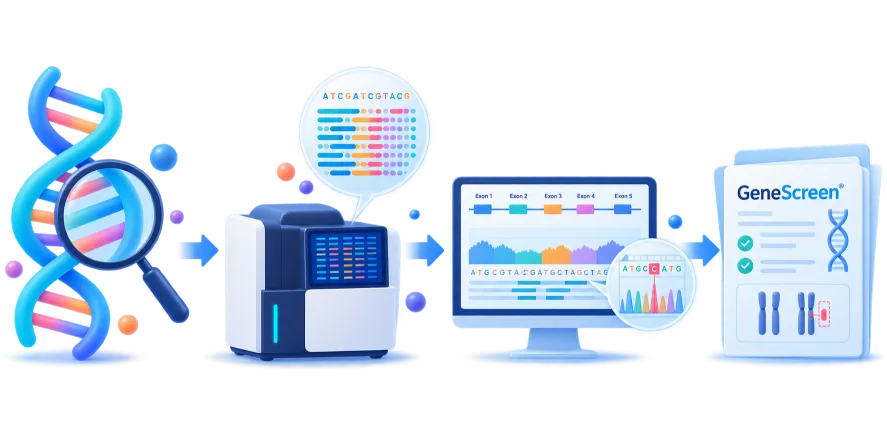
A blood sample is taken from the arm for the test. DNA is analysed using Next-Generation Sequencing (NGS) and any necessary supplementary methods. According to the manufacturer's information sheet, the turnaround time is approximately 20 working days from the sample's arrival at the testing laboratory. Shipping and the need for additional investigations may affect the total turnaround time.
Where can I have the GeneScreen® test in Northern Cyprus, and how much does it cost?
For information about arranging the test and sample collection, you can contact the Wellcare Laboratories branches at Wellcare Health Clinic and Miracle Hospital in Nicosia, or the branch at Medicalport Tunççevik Hospital in Kyrenia. The cost varies depending on the selected panel, whether testing is for an individual or a couple, and any additional matching analyses.