
What Is OncoNext Risk?
What Is the Relationship Between Cancer and Genetics?
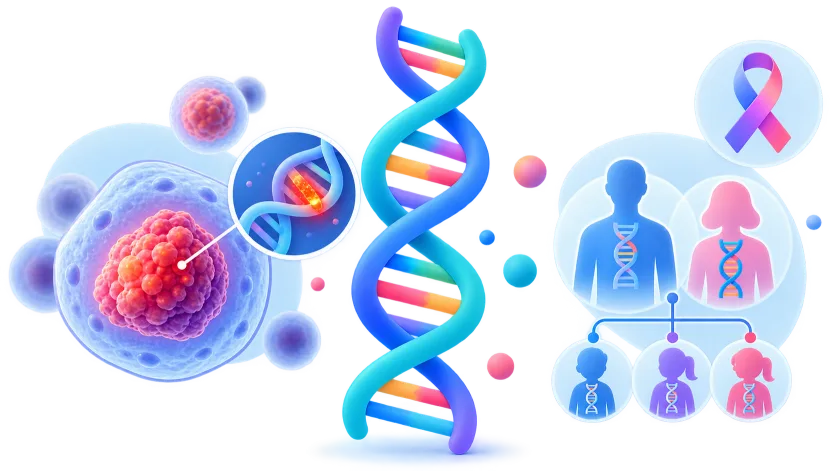
In contrast, some genetic changes may be present in the egg or sperm cell. These changes, called germline or hereditary mutations:
May be present in all cells of the body from birth.
May increase the risk of developing certain cancers.
May be passed from mother or father to child.
The brochure states that approximately 5-10% of cancers may be associated with hereditary germline mutations. However, detecting a hereditary genetic change does not necessarily mean that a person will develop cancer; it only indicates that the risk for some cancers may be higher than the population average.
Why Is It Performed?
Knowing a hereditary predisposition can help with:
- More accurate assessment of personal cancer risk,
- Starting screenings at an earlier age,
- Tailoring the frequency of screening to the individual,
- Evaluating risk-reducing measures,
- Supporting clinical follow-up and certain treatment decisions in people diagnosed with cancer,
- Identifying family members who may be at risk



THE ONCONEXT RISK TEST MAY BE RECOMMENDED IN THE FOLLOWING SITUATIONS
Who Is It Recommended For?
How Is It Performed?
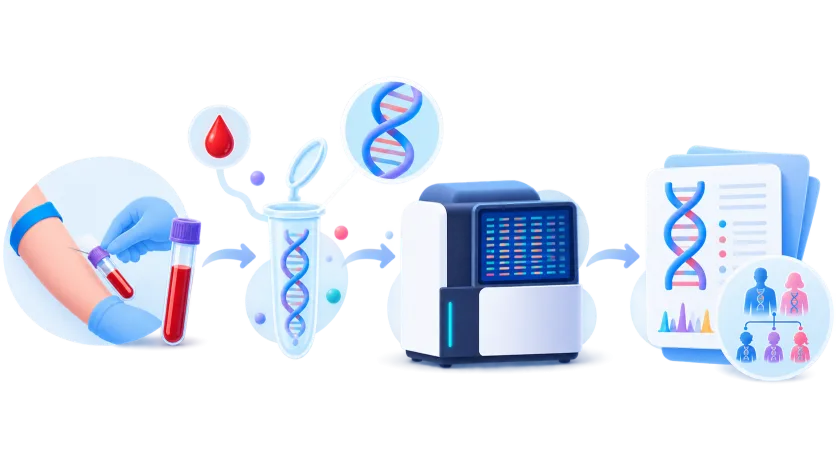
For the OncoNext® Risk test, a blood sample in an EDTA tube is usually collected. DNA is obtained from the blood sample, and the genes in the selected panel are analyzed by NGS.
This test does not examine tumor tissue; it investigates the genetic changes that a person has carried since birth and that may have been inherited from their family.
What Does a Positive Result Mean?
- ✓ Does not definitively indicate that the person will develop cancer.
- ✓ Indicates that the cancer risk may be higher than the population average.
- ✓ The degree of increased risk varies depending on the gene and the type of cancer.
- ✓ May allow a personalized follow-up and screening program to be created.
- ✓ May lead to genetic testing being recommended for close family members.
What Does a Negative Result Mean?
However, a negative result does not mean:
- ✓ That the cancer risk has been completely eliminated,
- ✓ That the person will never develop cancer in their lifetime,
- ✓ That family history is no longer important
Cancer risk can also be affected by age, family history, lifestyle, environmental factors and genetic factors not covered by the test. Therefore, the follow-up plan should be determined not only by the genetic test result but by taking into account all of the person's clinical characteristics.
What Does an Uncertain Result Mean?

Why Is Genetic Counseling Important?
- ✓ Personal cancer history,
- ✓ Age at cancer diagnosis,
- ✓ Types of cancer seen in the family,
- ✓ Ages at diagnosis of relatives,
- ✓ Previous genetic tests
After the test, what the detected change means for personal risk, the follow-up program and family members should be explained. For this reason, it is recommended that the test be performed and interpreted with genetic counseling.
With next-generation NGS technology
OncoNext® Risk Panels
Complete (82 genes)Breast + Colon + Stomach + Melanoma + Ovary + Pancreas + Prostate + Thyroid
- All genes in the Breast + Colon + Stomach + Melanoma + Ovary + Pancreas + Prostate + Thyroid panels
- The most comprehensive panel
Breast13 genes
- ATM, BARD1, BRCA1, BRCA2, BRIP1, CDH1, CHEK2, PALB2, RAD51C, RAD51D, STK11, TP53, PTEN
Colon19 genes
- APC, BMPR1A, CDH1, EPCAM, GREM1, MLH1, MSH2, MSH6, MUTYH, PMS2, PIK3CA, POLD1, PTEN, SMAD4, STK11, TP53, KRAS, PMS1, TGFBR2
Stomach11 genes
- APC, BMPR1A, EPCAM, MLH1, MSH2, MSH6, PMS2, STK11, SMAD4, TP53, CTNNA1
Melanoma8 genes
- BAP1, BRCA2, CDK4, CDKN2A, MITF, PTEN, RB1, TP53
Ovary15 genes
- BRCA1, BRCA2, BRIP1, EPCAM, MLH1, MSH2, MSH6, PALB2, PMS2, PTEN, RAD51C, RAD51D, STK11, CHEK2, ATM
Pancreas14 genes
- ATM, BMPR1A, BRCA1, BRCA2, CHEK2, CDKN2A, EPCAM, MLH1, MSH2, MSH6, PALB2, PMS2, STK11, TP53
Prostate13 genes
- ATM, BRCA1, BRCA2, CHEK2, EPCAM, HOXB13, MLH1, MSH2, MSH6, NBN, PALB2, TP53, PMS2
Thyroid1 gene
- RET
We Are Just a Message Away
Reach Us on WhatsAppOncoNext® Risk: About the Hereditary Cancer Genetic Test
Frequently Asked Questions
What is the OncoNext® Risk test?
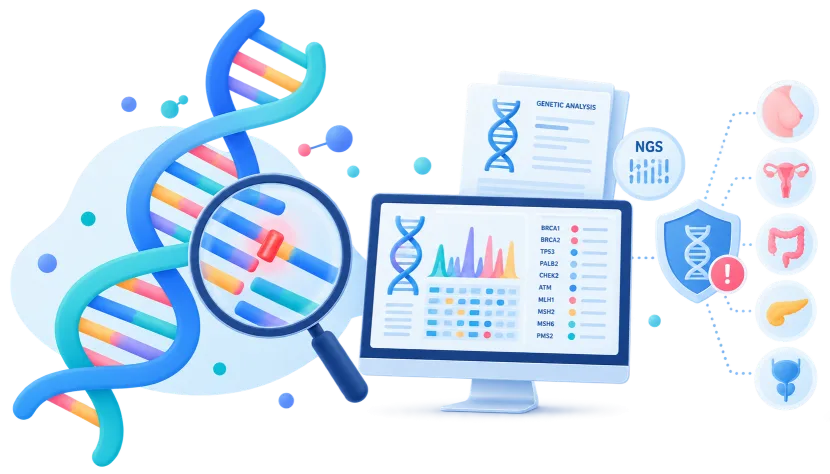
OncoNext® Risk is a test that investigates genetic changes associated with an inherited predisposition to certain types of cancer. Offered by Eurofins Genoma, the test allows the analysis of up to 82 genes, depending on the panel selected. Results are assessed alongside personal and family cancer history.
Is cancer genetic? Is every cancer hereditary?
Genetic changes play a role in the development of cancer; however, not all of them are inherited from a parent. Changes that arise in cells during a person's lifetime differ from inherited changes that can be passed down within a family. OncoNext® Risk investigates changes associated with inherited predisposition.
Does OncoNext® Risk show whether I have cancer?
No. It is not used to detect an existing tumour or diagnose cancer. It investigates genetic changes that may predispose a person to certain cancers. It does not replace the assessment of symptoms, a medical examination, or any necessary imaging or biopsy procedures.
Who may be considered for hereditary cancer testing?
Genetic assessment may be particularly useful in the following situations:
• The same or related cancers occurring in several family members.
• A cancer diagnosis at a younger age than expected.
• More than one independent cancer or bilateral breast cancer in the same person.
• A genetic change associated with cancer predisposition has been identified in the family.
The need for testing is determined according to the cancer type and individual characteristics.
If cancer runs in my family, do I definitely need this test?
Not every family history of cancer requires genetic testing. It matters which relative had cancer, what type of cancer they had, and at what age it occurred. The history on both the mother's and father's sides is assessed together to decide whether testing is necessary.
Can people who have not been diagnosed with cancer also have OncoNext® Risk testing?
Yes. It may be considered for healthy individuals, particularly if there is a family history or a known genetic change in the family. However, it is not a routine check-up test for everyone; assessing suitability before testing is important.
Is the test useful for people who have been diagnosed with cancer?
Yes. It may help assess whether the cancer is associated with an inherited predisposition and plan the necessary investigations for family members. Some findings may also contribute to treatment decisions; this assessment is made by an oncologist.
For which types of cancer does OncoNext® Risk offer panel options?
Panel options are available for breast, ovarian, colorectal, pancreatic, prostate, stomach and thyroid cancers, as well as melanoma. A BRCA1–BRCA2 panel and the more comprehensive OncoScreening Complete option are also available. Each panel covers a different set of genes.
Is the test suitable only for women?
No. Inherited cancer predisposition can affect both women and men. OncoNext® Risk options also include panels related to cancers such as prostate, colorectal and pancreatic cancer.
How is the OncoNext® Risk test performed? Is fasting required?
A blood sample is taken from the arm for DNA analysis. Fasting is generally not required for genetic testing. If other tests are to be performed on the same day, their preparation requirements must be followed.
If my result is positive, will I definitely develop cancer?
No. Identifying a pathogenic or likely pathogenic change associated with cancer predisposition may indicate an increased risk of certain cancers. However, it does not mean that cancer will definitely develop or indicate when it might occur.
What happens after a positive result?
The finding is assessed as part of genetic counselling. Depending on the gene involved and personal history, screening that starts earlier or is performed more frequently, along with appropriate risk-reducing options, may be discussed. Testing may also be recommended for family members when necessary.
If my result is negative, is my cancer risk eliminated?
No. A negative result means that no disease-associated change was identified within the scope of the test. It does not rule out all hereditary causes or the possibility of developing cancer during your lifetime. Follow-up continues according to your personal and family history.
What does “variant of uncertain significance” or VUS mean?
It means there is insufficient information to explain how an identified genetic change is related to disease risk. It is not the same as a positive result. It should not, on its own, be the basis for decisions such as preventive surgery; it may be reclassified over time.
Does OncoNext® Risk replace mammography or colonoscopy?
No. Genetic assessment helps guide screening plans for suitable individuals. It does not replace mammography, colonoscopy or other check-ups recommended based on age, family history and other risk factors.
Why might OncoNext® Risk be chosen?
As part of Eurofins Genoma's genetic analysis services, OncoNext® Risk offers panels for specific cancer types as well as broader panel options. The ability to analyse multiple genes together using NGS supports assessment tailored to the clinical history. When choosing a test, not only the number of genes but also the scope of testing and specialist interpretation of the results are important.
Where can I arrange an OncoNext® Risk test in Northern Cyprus?
For information about the test and to arrange testing, you can contact the Wellcare Laboratories branches at Wellcare Health Clinic and Miracle Hospital in Nicosia, and at Medicalport Tunççevik Hospital in Kyrenia. The appropriate panel and sample collection process are assessed before proceeding.