
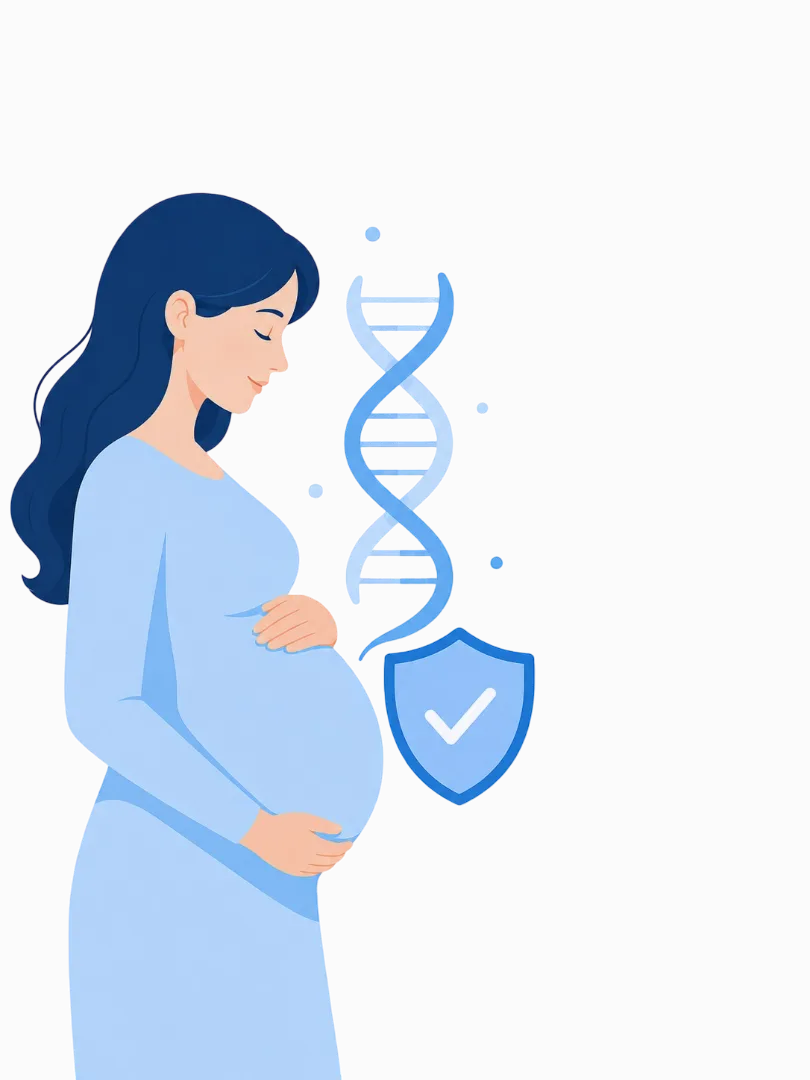
What is PaternitySafe?
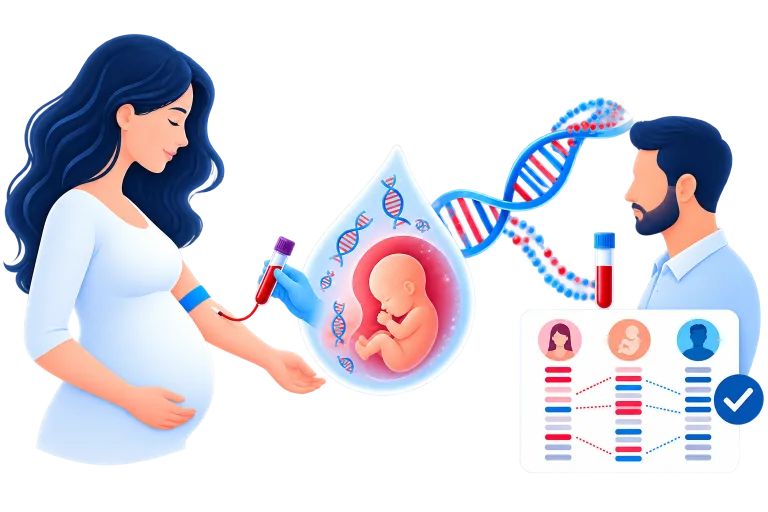

Why is it done?
Traditional prenatal paternity tests may require sampling from the amniotic fluid or placenta. These procedures are invasive and are performed only with appropriate medical indications. In the PaternitySafe test, however, a blood sample is taken from the expectant mother and a buccal swab sample is taken from the alleged father.
Therefore, the test:
• Does not interfere with the environment in which the mother and baby are located.
• Does not require surgical or interventional sampling.
• Allows paternity to be assessed safely during pregnancy.
How Does It Work?
01
Plasma is separated from the expectant mother's blood
02
The cell-free DNA of the mother and baby in the plasma is examined
03
The DNA is analyzed using Next-Generation Sequencing.
04
It is compared with the DNA in the buccal swab sample taken from the alleged father
05
A paternity assessment is made based on the genetic match obtained.
When can it be done?
Although the brochure states that fragments of the baby's DNA can be detected in the mother's blood from the early stages of pregnancy, for the PaternitySafe test it is recommended that the blood sample be taken from the expectant mother at 10 weeks of gestation at the earliest .
It is appropriate for the gestational age to be confirmed by ultrasound or a doctor's assessment.


How Is It Done?
Approximately 3 mL of blood sample is taken from the expectant mother.
A buccal swab sample is taken from the alleged father.
What are the advantages?
It is non-invasive
It does not require sampling from the amniotic fluid or placenta. Therefore, the environment in which the baby is located is not entered for the purpose of the test.
Can be performed in early pregnancy
The test can be performed from the recommended gestational week onward, without waiting for the baby to be born.
Advanced technology is used
The small amount of the baby's DNA in the mother's blood is examined using Next-Generation Sequencing and advanced bioinformatic methods.
Offers high accuracy
The test's sensitivity and specificity are above 99%, so paternity results are reported with high reliability.

How are the results reported?
At the end of the test, one of two results is usually given; if the proportion of the baby's DNA is low, a result may not be possible and a new blood sample may be requested.
Paternity Confirmed
The alleged father cannot be excluded as the baby's biological father. When the genetic characteristics match, the result can be reported with a paternity probability of over 99.9% .
Paternity Excluded
No genetic match is found, and it is concluded that the alleged father is not the biological father.
How long does it take to get the result?
The laboratory analysis time is usually 15 working days.

What should be considered before the test?
- Gestational age,
- Whether it is a singleton or multiple pregnancy,
- Whether she has recently had a blood transfusion,
- History of organ or bone marrow transplantation,
- Whether the pregnancy resulted from a donor egg,
- History of a vanishing twin
must be reported to the laboratory. These situations may affect the distribution of DNA in the mother's blood and may require a separate assessment of the test's applicability.
Before the buccal swab is taken from the alleged father, he may be required not to eat, drink, smoke or chew gum for the period specified by the laboratory.
Why is the mother's sample needed?
The mother's blood contains DNA fragments belonging to both the mother and the baby. Knowing the mother's genetic characteristics helps to identify the baby's portion more accurately.
Therefore, the test is performed not only with the sample taken from the alleged father but together with the expectant mother's blood sample.

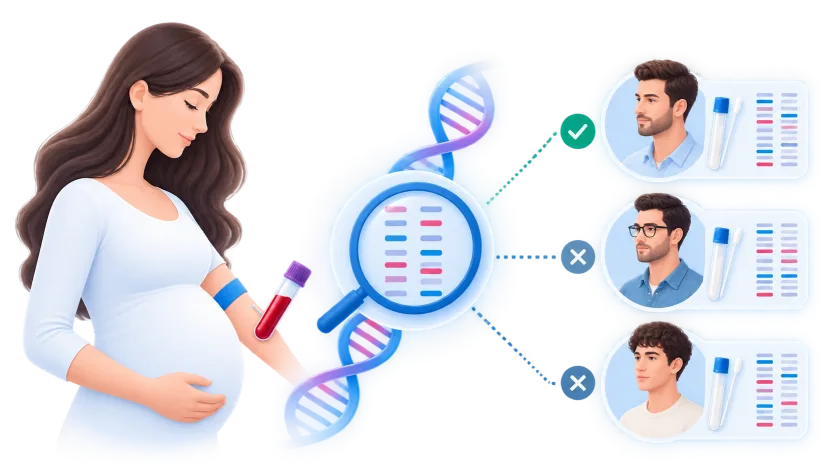
What if there is more than one alleged father?
We Are Just a Message Away
Reach Us on WhatsAppPaternity test options
PaternitySafePaternity test
- PaternitySafe® is a non-invasive prenatal paternity test that helps identify the baby's biological father during pregnancy.
- It can be performed from the 10th week of pregnancy.
Paternity testPaternity test
- Standard paternity test
PaternitySafe®: About Paternity Testing During Pregnancy
Frequently Asked Questions
What is the PaternitySafe® test?
PaternitySafe® is a non-invasive DNA test used to assess biological paternity before the baby is born. Pregnancy-derived cell-free DNA in the mother's blood is compared with a DNA sample from the alleged father.
Can paternity testing be performed before the baby is born?
Yes. Paternity can be assessed by examining DNA fragments present in the mother's blood during pregnancy, which originate mainly from the placenta. There is no need to wait until the baby is born for PaternitySafe®.
From which week of pregnancy can paternity testing be performed?
PaternitySafe® can be performed from the 10th week of pregnancy. It is important to assess gestational age and the number of babies by ultrasound before sample collection.
How is the PaternitySafe® test performed?
A blood sample is collected from the mother, and a swab sample is taken from the inside of the alleged father's cheek. DNA analysis is performed in the laboratory to compare genetic characteristics and assess the paternity relationship.
Does paternity testing during pregnancy harm the baby?
PaternitySafe® does not involve any intervention in the uterus or gestational sac. As only a blood sample from the mother's arm is required, it does not carry the risk of miscarriage associated with amniocentesis or chorionic villus sampling.
Does the alleged father need to provide a blood sample?
No. In standard practice, the alleged father's DNA is obtained from a cheek swab sample. Cells are collected from the inside of the cheek using a special swab.
Can more than one alleged father be tested?
Yes, samples can be collected from additional alleged fathers for comparison. Sample collection, consent documents, fees and the reporting process should be planned with the laboratory before applying.
Does it matter if the alleged fathers are related to each other?
Yes. If the alleged fathers are related, this must be disclosed before testing. In particular, if the alleged fathers are identical twins, PaternitySafe® cannot be used to distinguish between them.
How reliable is PaternitySafe®?
Sensitivity and specificity are reported to be above 99%, and the probability of paternity is reported to be above 99.9% in results that support paternity. These values represent different measures; they do not mean that the test is error-free or that a result will be obtained from every sample.
What does a probability of paternity above 99.9% mean?
It means that a genetic match has been found that very strongly supports the tested alleged father being the biological father. The result is interpreted together with the statistical assessment stated in the report and the limitations of the test.
What does a “paternity excluded” result mean?
It means that the genetic characteristics examined are not consistent with a paternity relationship and that the tested individual is excluded as the biological father. This result does not establish that another person who has not provided a sample is the father.
Is it possible for the test not to produce a result?
Yes. The result may remain inconclusive because of an insufficient amount of pregnancy-derived DNA or problems with the sample. Another blood sample may be requested at a later stage of pregnancy. Failure to obtain a result does not mean that paternity has been excluded.
Can PaternitySafe® be performed in twin pregnancies?
It can be performed in some identical twin pregnancies; however, not every twin pregnancy is suitable. The characteristics of the twin pregnancy and the ultrasound findings must be assessed by the analysing laboratory before the test is accepted.
Does a history of a vanishing twin affect the result?
Yes. DNA from a twin that has stopped developing may be present in the mother's blood and may affect the assessment. An initially multiple pregnancy or a history of a vanishing twin must be disclosed.
Can the test be performed in IVF or egg donation pregnancies?
Suitability is assessed according to the reproductive method used. In pregnancies involving egg donation, a sample from the donor may be required. This information should be shared with the laboratory before testing.
How long does it take to receive the PaternitySafe® result?
Results are ready within 15 working days. Sample shipment, repeat sample collection or additional assessments may extend this timeframe. The current estimated turnaround time is provided when you apply.
Where is the test analysed?
Testing is performed at Genoma laboratories in Italy. Appointments and sample collection can be arranged through Wellcare Laboratories.
Why choose PaternitySafe®?
It enables paternity assessment during pregnancy without an invasive procedure. Only a blood sample from the mother and a cheek swab from the alleged father are required. DNA profiles are compared using Next-Generation Sequencing (NGS) and bioinformatic analysis.
Can the PaternitySafe® result be used in court?
Eurofins Genoma describes the PaternitySafe® service as a test for informational purposes. Therefore, the standard test should not be assumed to be sufficient for legal proceedings. If legal use is being considered, the acceptance requirements of the relevant authority and the required sample collection procedure should be clarified before testing.
Is consent required for the test?
Information and consent documents are completed as part of the application. Consent from those providing samples, identity verification and who will receive the results should be clarified before applying.
Where can I apply for the PaternitySafe® test in Northern Cyprus?
For information and applications, you can contact the Wellcare Laboratories branches at Wellcare Health Clinic and Miracle Hospital in Nicosia, or the branch at Medicalport Tunççevik Hospital in Kyrenia. Test suitability and the appointment process are assessed before you provide a sample.