
What is WES?
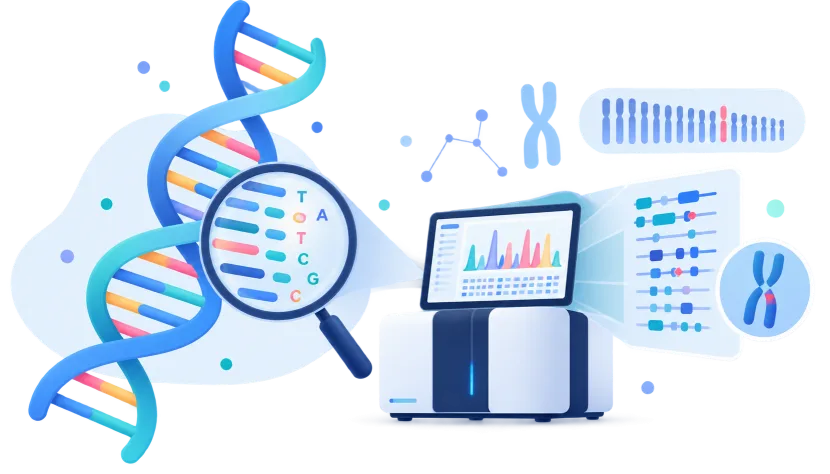
Today, many hereditary diseases are caused by genetic changes located in these regions. Instead of examining genes one by one, WES analyzes thousands of genes at the same time to investigate the genetic cause of the disease and can speed up the diagnostic process.


Your doctor may recommend the WES test in the following situations:
When Is WES Recommended?
How Is the Test Performed?

Advantages of the WES Test
- ✓ Simultaneous examination of about 22,000 genes
- ✓ Comprehensive analysis for many rare genetic diseases
- ✓ Contributes to speeding up the diagnostic process
- ✓ Helps reduce unnecessary additional tests
- ✓ Supports the creation of personalized treatment and follow-up plans
- ✓ Provides genetic data that can be re-evaluated in the future when needed
How Long Do the Results Take?
The result of the WES analysis is usually prepared within about 4 weeks. When necessary, a detailed genetic evaluation and clinical interpretation by the specialist team are added to the report.
Why Wellcare Laboratories?
To our patients we offer:
- ✓ Analysis in line with ISO 15189 accreditation standards
- ✓ Next-Generation Sequencing (NGS) technology
- ✓ Results interpreted by experienced clinical geneticists
- ✓ Reliable reporting in line with international quality standards
- ✓ Secure digital data management
and in this way we aim to provide genetic diagnostic services at the highest quality standards.
Does WES Have Limitations?
Does WES Have Limitations?

We Are Just a Message Away
Contact Us on WhatsAppAbout Whole Exome Sequencing (WES)
Frequently Asked Questions
What is the WES test?
Whole Exome Sequencing (WES) is a comprehensive genetic analysis that examines the regions of thousands of genes responsible for protein production. It helps investigate genetic changes that may explain a patient's symptoms and supports the diagnosis of genetic disorders.
Who may be suitable for WES testing?
It may be considered for children and adults with a suspected genetic disorder. It may be particularly useful in cases of developmental delay, intellectual disability, congenital anomalies, unexplained neurological findings, or suspected inherited kidney or heart disease. It may also be useful for patients whose previous tests have not provided a diagnosis. Suitability is determined based on clinical findings and family history.
What is the difference between WES, a gene panel and whole genome testing?
A gene panel focuses on selected genes associated with a specific disease or group of diseases. WES examines the protein-coding regions of genes more broadly. Whole Genome Sequencing (WGS) evaluates both coding and non-coding regions of DNA. The most appropriate test is selected according to the condition being investigated.
Can WES diagnose autism or psychiatric disorders?
WES alone does not diagnose autism, schizophrenia or bipolar disorder. However, it may help investigate an underlying genetic condition, particularly when developmental delay, intellectual disability, congenital anomalies or unusual clinical findings are also present. It is not a test that needs to be performed routinely for every psychiatric patient.
What do Solo, Duo and Trio WES mean?
Solo WES examines only the patient; Duo WES examines the patient and usually one biological parent; Trio WES examines the patient and both biological parents together. Comparing family samples may help determine whether identified changes are inherited or have arisen for the first time in the individual, and may aid interpretation of the results.
How is WES testing performed, and how many weeks do results take?
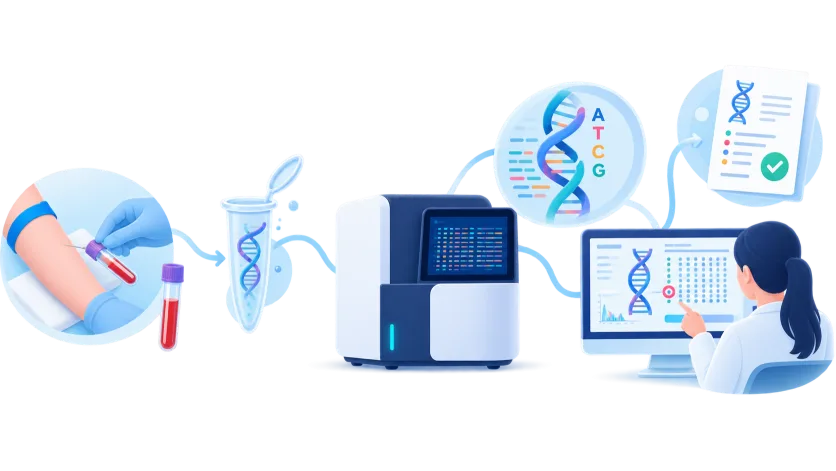
An EDTA blood sample taken from the arm is generally used. For Trio analysis, separate samples are also collected from the mother and father. The shared Eurofins Biomnis brochure indicates approximately 4 weeks for a detailed report; sample shipping and additional investigations may extend the total turnaround time. Clinical information, previous test results and family history should also be shared with the laboratory to ensure accurate interpretation.
What does a positive, negative or uncertain WES result mean?
Identifying a disease-causing change that explains the patient's findings may support or confirm a genetic diagnosis. A negative result does not completely rule out a genetic disorder. A “variant of uncertain significance” (VUS) is a change whose association with disease is not yet clear; on its own, it is insufficient for a definitive diagnosis or treatment decision. Results should be evaluated with genetic counselling.
Does WES detect all genetic disorders? Can the result be reassessed later?
No. WES may not detect certain genetic changes, repeat expansions or changes in non-coding regions. The scope of chromosomal copy number variation (CNV) analysis and other additional analyses varies depending on the method used; other tests may be required. Reanalysis of existing WES data may be useful when new scientific knowledge or new clinical findings become available.
Can WES results help guide treatment selection?
For some conditions, identifying the genetic cause may change the monitoring and treatment plan; however, not every result directly leads to a treatment. Pharmacogenetic analysis related to drug metabolism may be offered as a separate or additional assessment and should not be assumed to be automatically included in a standard WES report. In addition, the investigation and reporting of health findings unrelated to the reason for testing should be discussed as part of the consent process before the test.
Are all WES tests the same? What differences are there between laboratories?
No. Although WES tests share the same name, they may differ in how well genes are sequenced, which genetic changes are investigated and how results are interpreted. Looking only at the number of genes examined is not enough. Sequencing quality, the scope of additional analyses, expert assessment, the use of the patient's clinical information and the ability to reanalyse data when needed are important. Therefore, when choosing a test, both the price and the scope of analysis and reporting should be considered.
Why might I choose Eurofins Biomnis for WES testing?
Eurofins Biomnis may be a preferred choice because of its ISO 15189-accredited laboratory infrastructure, experience in genetic analysis and approach to interpretation in collaboration with the clinician. According to the shared technical information, approximately 98% of targeted gene regions are examined at a sequencing depth greater than 30-fold. This means that DNA regions are read repeatedly to support the quality of the analysis.
The SeqOne bioinformatics platform enables genetic findings to be assessed alongside the patient's symptoms and family history. The ability to reanalyse existing data when needed and the provision of secure access to raw data are also important advantages. The aim is to turn genetic data into meaningful information that can be used in the patient's diagnosis and follow-up.
Where can I have WES testing in Northern Cyprus, and how much does it cost?
For information about WES testing and sample collection, you can contact the Wellcare Laboratories branches at Wellcare Health Clinic and Miracle Hospital in Nicosia, and at Medicalport Tunççevik Hospital in Kyrenia. The price varies depending on the choice of Solo, Duo or Trio testing, the scope of interpretation and additional analyses. The appropriate test and current turnaround time are assessed before proceeding.