
Your Partner in Health and Wellness
Location
Monkeypox
General Information
Monkeypox (Mpox disease) is caused by the monkeypox virus, a member of the Orthopoxvirus genus in the Poxviridae family. Other members of the Orthopoxvirus genus, such as Camelpox, Cowpox and Variola, are zoonotic viruses that can also be seen in other animal species. Variola, commonly known as smallpox, was eradicated worldwide in 1980 through effective vaccination.
Monkeypox is an infection that is endemic in Central and West Africa; since 2022 it has also been spreading outside Africa through close/sexual contact.
Clinically, monkeypox presents with fever, malaise, fatigue, headache, rash and swollen lymph nodes, and can cause a number of medical complications.
Monkeypox is generally a self-limiting disease with symptoms lasting 2-4 weeks. Severe cases can occur. In recent cases, the case fatality rate has been as high as 10% in Central Africa and 1% in West Africa, and is below 1% in other geographic areas where the disease is rarely seen.
Natural Host
Various animal species susceptible to the monkeypox virus have been identified. These include rope squirrels, tree squirrels, Gambian pouched rats, dormice, primates and other species. The natural course of the monkeypox virus has not yet been clearly defined. The exact reservoir(s) and how the virus circulates in nature are not yet clear.
Mode of Transmission
The monkeypox virus is transmitted to humans through close contact with an infected person or animal, or with materials contaminated with the virus. The disease can pass from one person to another through lesions, body fluids, respiratory droplets and contaminated items such as bedding. Droplet transmission generally requires prolonged face-to-face contact, which puts healthcare workers, household members and close contacts of active cases at risk. In recent years, the longest person-to-person transmission chain has gone from 6 to 9 people. This may be due to declining immunity in the population because smallpox vaccination is no longer carried out. Mother-to-baby transmission can occur during pregnancy and birth, and through close contact afterwards.
Symptoms
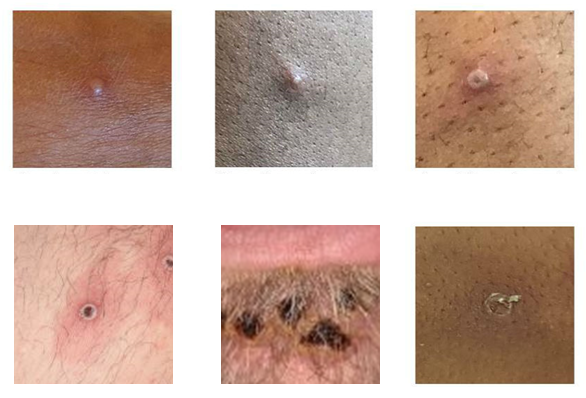
The incubation period of monkeypox is usually 6-13 days but can range from 5 to 21 days. The infection can be divided into two periods. The first period, characterized by fever, headache, swollen lymph nodes, back pain, muscle pain and malaise, lasts from day 0 to day 5. Swollen lymph nodes are a distinctive feature of this disease and are important in distinguishing it from measles, smallpox and chickenpox. The skin rash begins 1-3 days after the fever. The rash is more concentrated on the face, arms and legs than on the trunk. The face (95%), palms and soles (75%) are affected. The oral mucosa (70%), genital area (30%) and conjunctiva (20%) are also affected. Since 2022, the rash often starts in the genital/anal area and proctitis is common; fever and swollen lymph nodes may be absent. The rash first develops as flat-based lesions slightly raised from the skin, which then become filled with clear fluid and later yellowish fluid. There may be a few lesions or thousands. Symptoms resolve on their own within 2-4 weeks. Children can have a severe course of the disease. It can also be severe in people with immunodeficiency. Although smallpox vaccination previously offered protection, today, depending on the country, people under 40-50 years of age are more susceptible to the disease. Complications may include lung infection, sepsis, vision loss and encephalitis (inflammation of the brain).
Treatment
Smallpox vaccine, antivirals and intravenous immune globulin (VIG) may be used to keep a monkeypox outbreak under control. However, the original (first-generation) smallpox vaccines are currently no longer available to the public. Although a vaccine (MVA-BN) was approved for monkeypox in 2019, this countermeasure is not yet widely available, and populations worldwide under 40 or 50 years of age no longer benefit from the protection provided by previous smallpox vaccination programs. There is no proven effective antiviral for monkeypox; treatment is supportive. The EU approval of tecovirimat was withdrawn in 2026.
Is it fatal?
For the monkeypox virus, which is milder than smallpox, the death rate varies by clade: below 1% in clade II and higher in Central African clade I outbreaks. However, if you notice any of the symptoms of the monkeypox virus, you must see a specialist.
What should be done to reduce the risk of human-to-human transmission?
In light of the information available so far, the World Health Organization (WHO) states that close contact with people showing symptoms of the disease caused by the virus should be avoided and that these patients should be isolated.
How significant is sexual contact?
The monkeypox virus infects a person through the transmission of droplets by "close contact". In a statement by the World Health Organization, it was noted that the monkeypox virus is also spread through sexual intercourse. While it is stated that unprotected sexual intercourse should be avoided for this reason, this disease should not be considered solely a sexually transmitted infection.
Take precautions against the monkeypox virus
Surveillance, that is, systematic observation of the virus and rapid identification of new cases, is critical to bringing the outbreak under control. During outbreaks, close contact with infected people is the most important risk factor for monkeypox virus infection. Healthcare workers and household members are at greater risk of infection. Healthcare workers who care for monkeypox patients or collect samples from them should use gloves, a gown, eye protection and an N95/FFP2 respirator; the MVA-BN vaccine is recommended for workers at risk. Individuals should also pay attention to personal hygiene measures. In addition, care should be taken when using shared items and shared spaces.
Although the monkeypox virus is rare, the following precautions should be taken to minimize the risk of catching it while traveling:
Wash your hands regularly with soap and water or use an alcohol-based hand sanitizer.
Eat only well-cooked meat.
Take care not to touch the towels or clothing of infected people.
Do not have contact with people who may be carrying this virus.
What should you do if you think you have monkeypox?
First, symptoms must be examined in order to diagnose the disease. If, within the past 21 days, you have had close or sexual contact with someone suspected of having monkeypox, or have traveled to a high-risk region, and you have a rash or sores, you should go to a healthcare facility without delay. At healthcare facilities, a definitive diagnosis can be made with the PCR method, performed on a sample taken from the rash on the patient's body. After diagnosis, you should isolate yourself and avoid close contact with other people.