
Your Partner in Health and Wellness
Location
Frequently Asked Questions (FAQ) About Mpox (Monkeypox)
1. Is it a new disease?
Mpox (formerly monkeypox) is not a new disease. After it was identified in monkeys in 1958, the first human case was seen in 1970 in the Democratic Republic of the Congo. The disease then continued to be seen in 11 countries with tropical rainforests in Central and West Africa, chiefly Nigeria and the Democratic Republic of the Congo. Although the true incidence of mpox in those regions could not be precisely defined during this period, it was estimated that there were several hundred cases in Africa every year. Until 2022, the disease was occasionally carried from the African continent to other continents by infected animals or people, and small regional clusters of cases affecting a small number of people were observed in these places.
2. Why has it attracted so much attention now? What is the scale of the ongoing outbreak worldwide?
Until 2022, all cases seen outside Africa were known to originate from people coming from Africa or rodents brought in from Africa. However, since May 2022, mpox has been identified worldwide, chiefly in Europe and the USA, in people with no contact with Africa or with animals from there; the disease spread from person to person and has led to an outbreak that has so far affected more than a hundred thousand people. Because of this outbreak, in which mpox became widespread outside Africa for the first time in 2022 and was detected in about 100 countries including Turkey, the WHO declared a public health emergency of international concern on 23 July 2022. This enabled countries to take measures such as surveillance (monitoring) and vaccination of vulnerable groups, and the outbreak was brought under control. The WHO ended the global emergency on 11 May 2023. However, mpox cases, although few in number, have continued to be seen worldwide up to the present.
Since 2023, a serious mpox outbreak has begun in Africa, particularly in the Congo, caused by a subtype (1b) of Clade 1, a strain that can cause more severe infection. It has also spread to neighbouring countries such as Rwanda, Burundi and Uganda. For this reason, Africa CDC on 13 August 2024 and the WHO on 14 August 2024 again declared a public health emergency of international concern for the mpox outbreak. The WHO ended this emergency on 5 September 2025; mpox continues to be monitored. The main purpose of this declaration is to warn countries to take the necessary measures for diagnosis, surveillance, immunisation and treatment and to allocate resources for them, and thus to ensure that the outbreak is brought under control.
3. Is the causative agent of the disease known?
Yes, the causative agent of the disease is the mpox virus (Monkeypox Virus), a DNA virus related to the smallpox virus. Two different genetic subtypes are known to cause disease in Central and West Africa. The West African subtype (clade 2) causes milder disease compared with the Central African (Congo Basin) subtype (Clade 1). In the 2022 outbreak, which also affected countries outside Africa including our own, the virus strain called Clade 2, which was observed to cause milder infection, was responsible, whereas in the outbreak that began in the Congo in 2023, has spread and is still ongoing, the 1b strain, a subtype of Clade 1 that can cause more severe infection, is responsible. There is concern that, through the mutations this strain has undergone, it may also have acquired the ability to be transmitted more easily between people.
4. Is the virus transmitted to humans from monkeys?
Although "monkey" appears in its former name, it is a disease found more in rodents such as squirrels, rats and mice than in monkeys, and passed from them to humans. The reason the disease was renamed "mpox" instead of monkeypox is that including an animal or place name in disease names can lead to discrimination and stigmatisation.
The natural reservoirs and natural cycle of the mpox virus in nature are not fully known. To date, the virus has been isolated from animals in the wild only twice. It was first isolated in 1985 from an African squirrel in the Equateur region of the Democratic Republic of the Congo. The second was isolated in 2012 in the rainforests of Côte d'Ivoire from a dead juvenile primate belonging to a monkey species called the "mangabey". The natural reservoir therefore remains uncertain.
5. How is the virus transmitted to humans?
The virus is transmitted to humans through close contact with an infected animal, an infected person or inanimate objects contaminated with the virus (clothes, towels, sheets, etc.). The virus enters healthy people through cracks/scratches in the skin that cannot be seen with the naked eye, through mucous membranes (mouth, nose, eyes) or through the respiratory system. Transmission from infected animals to humans (zoonotic) can occur through bites, scratches, contact with the animal's blood and body fluids or meat, direct contact with lesions, or indirectly through inanimate material contaminated with any of these.
Person-to-person transmission of the virus is known to occur mainly directly through contact with the body fluids and skin lesions of an infected person, or indirectly through contact with inanimate objects contaminated with these, via the skin and mucous membranes. In the 2022 outbreak, close contact during sexual intercourse was an important route of transmission, particularly among men who have sex with men, whereas in the current ongoing outbreak in the Congo it has been reported that transmission occurs both through contact during heterosexual intercourse and through close contact within the household, and that the disease is seen in children and women as well.
6. Is it a disease similar to smallpox and chickenpox?
Diseases with a "pox" are similar diseases caused by viruses. Therefore, lesions similar to the skin lesions seen in smallpox and chickenpox are also seen in mpox. However, the location of the lesions on the body, their appearance and their course are all different. In addition, smallpox has been eradicated from the earth thanks to the vaccine. In mpox, swelling of the lymph nodes may also occur. The appearance of symptoms of the disease in people who have recently (within the last month) travelled to countries where the disease is seen, such as African countries, European countries and the USA, or in people who have had close contact with groups in which the disease is seen (men who have sex with men, sex workers, etc.), or in the contacts of a sick person, should suggest mpox.
7. What are its signs and symptoms?
Mpox causes fever, headache, fatigue, widespread body aches, swelling of the lymph glands and skin lesions (rashes). Complaints appear on average 6-13 days after contact with the virus.
In the first 5 days of the disease, fever, severe headache, swelling of the lymph glands, back pain and extreme weakness are seen. Most of these signs and symptoms can be seen in many diseases, but the presence of swollen lymph glands is particularly important in distinguishing it from smallpox, chickenpox and measles.
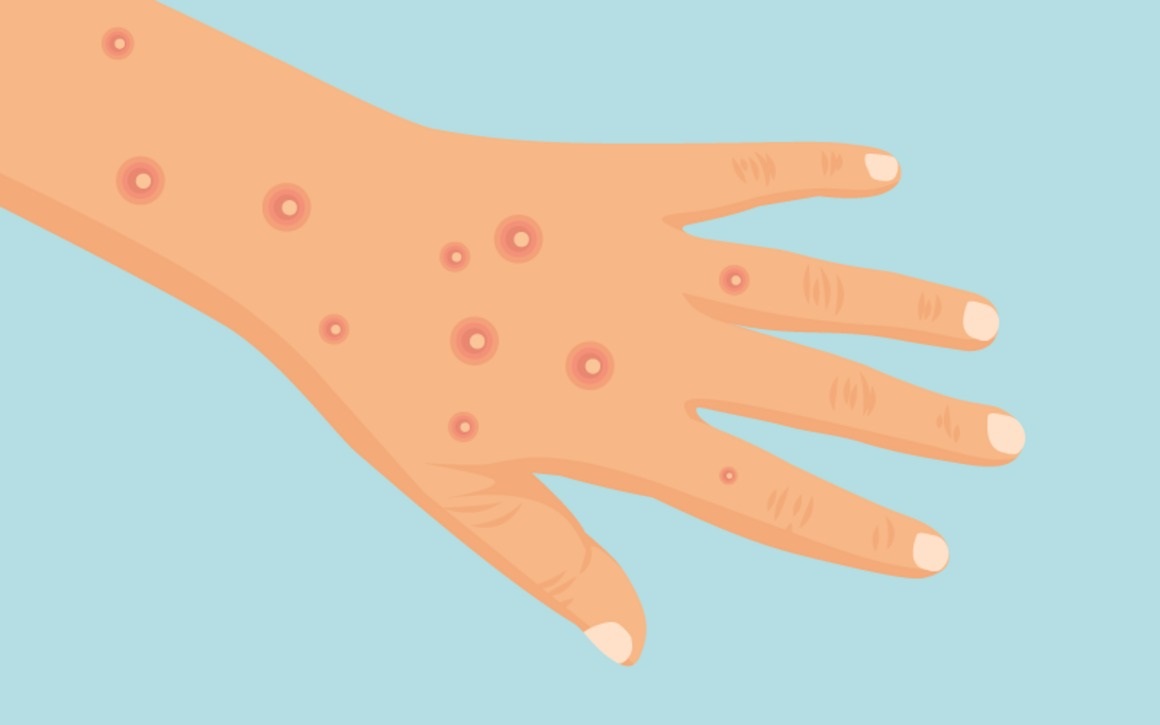
The rash on the skin appears within 1-3 days after the fever begins; it is seen more on the face, arms and legs than on the trunk. Lesions can be found on the palms and soles, inside the mouth, in the genital area and in the eyes. In the 2022 outbreak, proctitis, due to lesions developing in the rectal area, and tonsillitis, due to lesions developing on the tonsils, were also frequently seen.
The number of lesions varies; there may be few or very many. The lesions begin as a flat redness (macule), become raised from the skin (papule), and then fill with clear fluid and take on the appearance of a "vesicle". The clear fluid inside the vesicles turns into a yellowish fluid and "pustules" form.
The pustules form crusts, and when the crusts fall off the lesions disappear. This process usually lasts 2-4 weeks and resolves on its own. In people with suppressed immune systems, the disease can take a severe course. Bacterial infections may be added to the disease; pneumonia, sepsis, encephalitis and loss of vision may develop.
8. Can there be an asymptomatic infection?
Although asymptomatic mpox cases have been reported, it is known that this is quite rare and that the disease usually follows a symptomatic course. Since the appearance of symptoms in infected people allows these people to be noticed and isolated, mpox is not expected to spread in the community as much as COVID-19 or other infections that are transmitted while asymptomatic. However, the fact that the strain responsible in the Congo is spreading faster and in all groups is a cause for concern.
9. How long should people who have had contact with mpox be monitored?
Those who have had contact with animals or people confirmed to have mpox should be monitored for signs and symptoms for 21 days after the last contact.
10. How is the disease diagnosed?
For the disease to be recognised, it is first of all important that it comes to mind. People showing symptoms of the disease should be asked whether they have travelled to risk areas within the last month or whether they have had close contact with anyone with similar symptoms. In cases where mpox is suspected, samples properly obtained from the lesions and packaged with the necessary safety precautions must be sent to the relevant laboratory. As can be expected, this test cannot be performed in routine laboratories, but can only be performed in biosafety level 2 laboratories that have the necessary materials and staff. Today, diagnosis is based on demonstrating the virus's DNA in samples by PCR (polymerase chain reaction).
Diagnosing mpox from blood samples is not very feasible. Because the virus stays in the blood for a very short time, it is generally not possible to detect it by PCR. Antigen and antibody tests also do not always give accurate results because of, for example, previously administered smallpox vaccination.
11. Is the disease fatal?
Mpox usually resolves on its own within 2-4 weeks. However, severe disease can be seen in people with suppressed immunity and in young children. In general, 1-6% of those who fall ill, mostly young children, are unfortunately lost. In the Central African subtype (clade 1), the fatality rate can rise to 11%. In the outbreak currently ongoing in the Congo due to this strain, the death rate is around 5%. In the 2022 outbreak, the death rate was reported as very low, <1%.
12. Is there a treatment and a vaccine?
There is no widely used drug for mpox. The cases seen so far have been brought under control using antiviral drugs called cidofovir, brincidofovir and tecovirimat (ST-246) and smallpox immunoglobulin; however, their effectiveness has not been conclusively proven, and studies are continuing. There is no proven effective antiviral for mpox; tecovirimat is approved in the US only for smallpox, and its EU approval for mpox was withdrawn in 2026.
There is a vaccine called JYNNEOSTM (also known as Imvamune and Imvanex), approved by the FDA in 2019 for use against mpox in the USA. This attenuated vaccine is effective against smallpox and mpox and contains the Modified Vaccinia Virus Ankara strain. This strain was obtained by researchers at the University of Munich, to provide a safer vaccine, by serially passaging again in chicken fibroblast tissue cultures the Vaccinia Ankara strain, which had probably been developed as a smallpox vaccine strain at the Refik Saydam Hygiene Institute Vaccine Laboratories by serial passages of the horsepox virus. It is known to be available in limited quantities for use in people who work with such viruses in the laboratory and in those who have had contact during an outbreak. The vaccine can also be administered after contact.
13. Does the smallpox vaccine protect against mpox?
Based on experience in Africa, the World Health Organization reports that the smallpox vaccine provides up to 85% protection against mpox. However, the smallpox vaccine has not been administered since 1980. Therefore, people who have been vaccinated against smallpox are today aged 40-50 and over. After such a long period, it is difficult to say to what level the protection continues. In the 2022 outbreak, cases were also described in vaccinated people, although fewer than in unvaccinated people. Nevertheless, it has been observed that household transmissions in Africa were fewer among people who had received the smallpox vaccine and that they were protected from severe disease. It is recommended that, where possible, samples suspected of mpox in the laboratory be handled by vaccinated people.
14. Is there a possibility that it will cause a pandemic?
Considering factors such as the obvious signs and symptoms of mpox, the fact that it rarely causes asymptomatic infection, that it is transmitted by close and prolonged contact, and that, being a DNA virus, it undergoes fewer mutations and does not change easily (no new variants emerging as with COVID-19), it was not really expected to cause a pandemic like COVID-19. However, concerns have increased because in the ongoing 2023 outbreak all groups are affected, spread is faster and a higher death rate is seen. Even so, since it is not a virus transmitted by the respiratory route, it is not expected to cause a major epidemic similar to COVID-19.
15. Has a case been detected in the TRNC?
During the mpox outbreak that affected the whole world in 2023, one case was also detected in our country, the surveillance of the cases was carried out by the Ministry of Health, but no additional cases were detected.
16. How can mpox be prevented?
The disease can be prevented, and brought under control in the community, through identification, surveillance and isolation of sick people and identification of their contacts; use of appropriate personal protective equipment, above all gloves and masks, by healthcare workers and household members who will come into contact with sick people or the items they use; identification of groups at behavioural or occupational risk for the disease and vaccination of them; vaccination of people with risky contact; monitoring of other contacts; provision of the necessary drugs and vaccines; and correct information of the public by the health authorities throughout the whole process.