

What is AffinityMap?
Who may be offered the test?


What does it mean for pregnancy success?
When should it be performed?

What test options are available?
AffinityMapKIR
- Analysis of KIR genes
AffinityMapHLA‑C
- Analysis of HLA‑C genes
AffinityMapKIR & HLA‑C
- Combined analysis of both gene groups
About AffinityMap
Frequently Asked Questions
What is the AffinityMap test, and what is it used for?
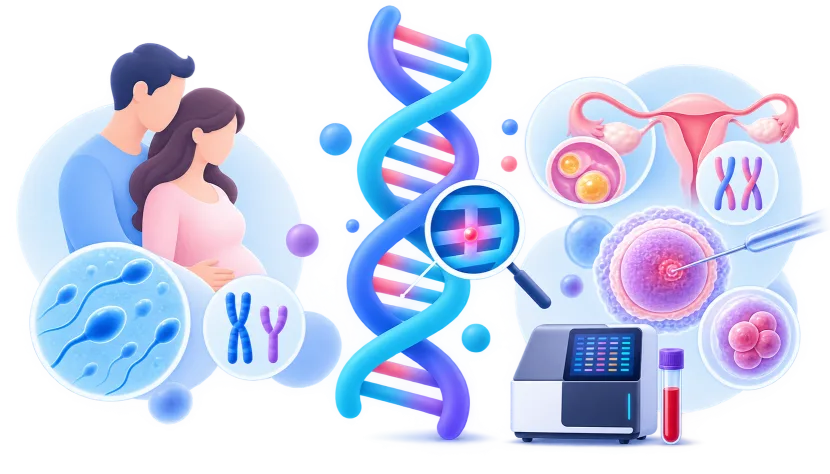
AffinityMap® is a genetic test that investigates the potential interaction between the prospective mother's KIR genes and the HLA-C characteristics the embryo inherits from its mother and father. These genes play a role in the biological communication between the maternal immune system and the placenta developing during pregnancy. The test can provide information about specific genetic combinations; however, it cannot predict with certainty whether pregnancy will occur.
Can genetic incompatibility between partners prevent conception?
It is normal for the mother and father to have different genetic characteristics, and this alone does not prevent pregnancy. Some studies have reported associations between certain combinations of maternal KIR genes and embryonic HLA-C characteristics and pregnancy outcomes. However, this does not mean that there is a definite incompatibility between partners or that it is a cause of inability to conceive.
What are KIR and HLA-C genes, and how are they related to pregnancy?
KIR genes encode certain receptors found on the surface of natural killer (NK) cells in the maternal immune system. HLA-C is one of the genetic characteristics involved in the interaction of embryonic and placental cells with the maternal immune system. This interaction is one of the important biological mechanisms being studied in relation to placental development and the continuation of pregnancy.
Is the AffinityMap test necessary in cases of recurrent miscarriage or embryo implantation failure?
Various causes need to be investigated in couples experiencing recurrent pregnancy loss or embryo implantation failure. AffinityMap can provide additional information about specific KIR/HLA-C genetic combinations. However, current scientific guidelines do not recommend these types of immunogenetic assessments as routine first-line investigations. Use of the test should be considered with the physician explaining the level of evidence and its limitations.
Do a KIR AA genotype and an HLA-C2 result pose a risk to pregnancy?
Some scientific studies have reported an association between the combination of a maternal KIR AA genotype and embryonic HLA-C2 characteristics and certain pregnancy complications. However, the presence of this genetic combination does not necessarily mean that miscarriage, embryo implantation failure or preeclampsia will occur. The result should not be used on its own for a definitive risk calculation or treatment decision.
How is the AffinityMap test performed? Are blood samples taken from the mother and father?
For AffinityMap, a peripheral blood sample is collected and DNA analysis is performed. The prospective mother's KIR genes and the mother's and father's HLA-C genetic characteristics are assessed according to the scope of the selected test. Samples from both partners may be requested for couples planning a natural pregnancy or using their own eggs and sperm. The samples required may differ in treatments involving donors.
On which day of the menstrual cycle is the AffinityMap test performed?
As AffinityMap is a genetic blood test, it does not need to be performed on a particular day of the menstrual cycle. It can be performed during pregnancy planning or before IVF treatment. The timing of the test should be determined according to the clinical decision for which the physician plans to use the result.
What is the difference between the AffinityMap KIR, HLA-C and KIR/HLA-C tests?
AffinityMap offers three different analysis options. AffinityMap KIR examines KIR genes; AffinityMap HLA-C examines HLA-C genetic characteristics. AffinityMap KIR/HLA-C assesses both gene groups together. The analysis required is determined according to the characteristics of the person who will carry the pregnancy and their partner, as well as whether donors are used.
Can incompatibility detected by the AffinityMap test be treated?
Identifying a particular KIR/HLA-C combination in an AffinityMap result does not necessarily indicate a disease requiring treatment. There is no proven treatment that changes these genetic characteristics. Starting immunosuppressive medication, cortisone or any other immunological treatment based solely on this test result is not recommended. Pregnancy-related decisions should be based on clinical history and evidence-based assessments.
Where is the AffinityMap test available in Cyprus, and how much does it cost?
The AffinityMap test is offered in Northern Cyprus through Wellcare Laboratories in collaboration with Eurofins Genoma. You can obtain information about the scope of the test, sample collection and the application process from Wellcare centres in Nicosia and Kyrenia. The price may vary depending on whether KIR alone, HLA-C alone or combined KIR/HLA-C testing is performed. Please contact Wellcare Laboratories for current pricing.